
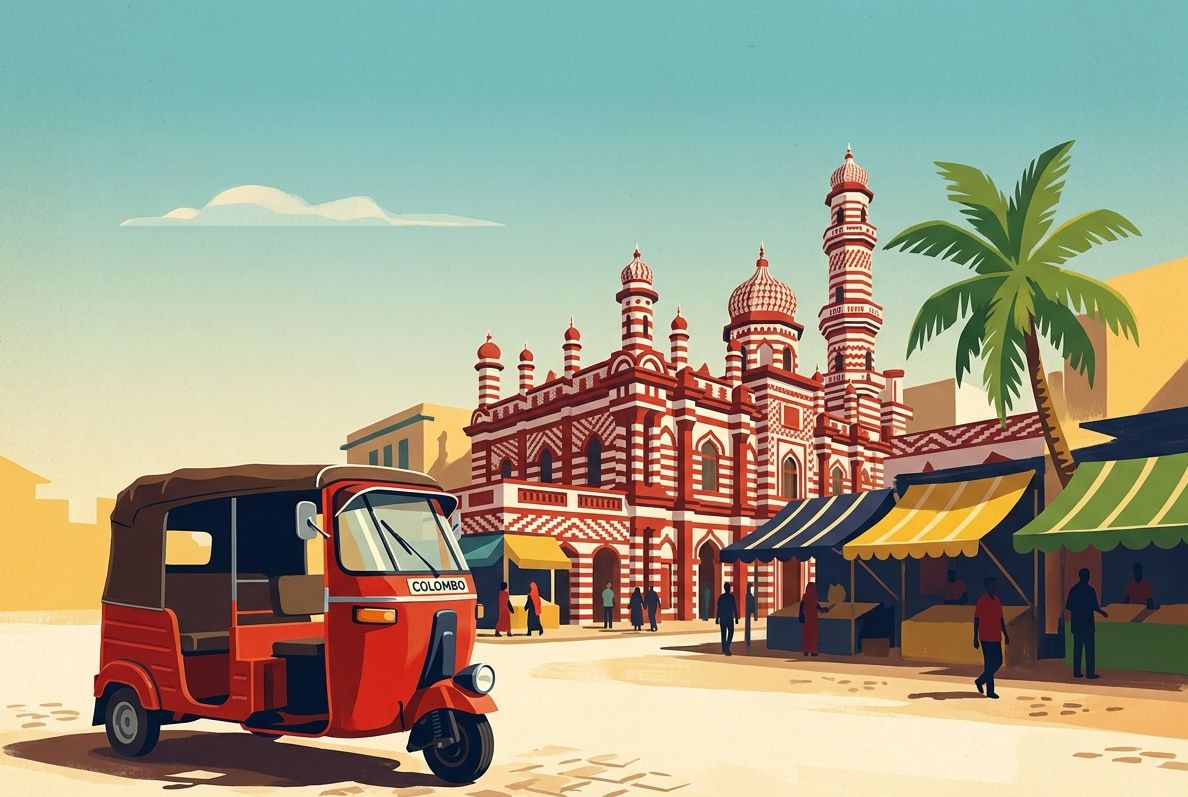
You can see most of what Colombo is known for in one day if you do it in the right order. Start at Gangaramaya Temple beside Beira Lake, move on to the old Fort, spend the middle of the day in Pettah’s markets, and finish on Galle Face Green as the sun goes down. Those places sit within about two and a half kilometres of each other in a straight line, so most of the day goes on looking and eating rather than travelling.
Below is the route with timings, what to wear, what to eat on the way and how to change the plan if it rains or you only have half a day.
The route at a glance
| Time | Stop | Allow |
|---|---|---|
| 8:00 | Gangaramaya Temple and Seema Malaka | 60 to 75 minutes |
| 9:30 | The Fort: Dutch Hospital and the old colonial streets | 60 to 90 minutes |
| 11:00 | Pettah markets and the Jami Ul-Alfar Mosque | About 90 minutes |
| 12:30 | Lunch | About an hour |
| 14:00 | Rest, or the Lotus Tower and Beira Lake | Flexible |
| 16:30 | Galle Face Green until after sunset | 90 minutes or more |
These timings are our own estimates, not official figures. Treat them as a starting point and stretch whichever stop you enjoy most.
Why this order
Colombo is hot all year. Average highs are around 31 °C in March and April, according to the climate section on Wikipedia’s Colombo page, and the city has two wet periods, April to June and September to November. The route puts the quiet, shaded stop first, the crowded streets in the middle of the morning and the open seafront at the end, when the heat has dropped and the sea breeze picks up.
It also follows the map. Gangaramaya is the furthest east, away from the sea, so you start there and work back towards the coast: Fort, Pettah, then the seafront. You never double back.
1. Gangaramaya Temple and Seema Malaka
Gangaramaya is one of Colombo’s best-known Buddhist temples, on Sri Jinarathana Road beside Beira Lake. It was completed in the late 19th century, and it is as much museum as temple. There is a vihara, a pagoda, a Bodhi tree, a relic chamber, a library and a large collection of statues and objects.
Down by the water, the Seema Malaka is the monks’ assembly hall, and it sits on the lake. It was designed by the architect Geoffrey Bawa. It is part of the same complex, and a good place to slow down.
One of the one-day guides we read recommends arriving early, before the crowds. Another puts the temple mid-afternoon. We would go first thing, because it is cooler and you are not tired yet.
Dress modestly: cover your shoulders and knees, and expect to take off your shoes and your hat. Slip-on sandals save time. Check the current entry fee at the gate. We could not confirm a figure from a reliable source, so we will not quote one.
More: Gangaramaya Temple visiting guide.
2. The Fort
The Fort is Colombo’s old colonial centre and today its business district. The area was called Kolonthota, and the Portuguese made their first landings here in the early 16th century. The Dutch East India Company took the fort in 1656, pulled down the Portuguese defences and rebuilt them. After the 1815 Kandyan Convention, Colombo became the capital of the whole island. Between 1869 and 1871 the northern, eastern and southern walls came down, and many Dutch buildings were replaced by British-style ones.
On the ground it is a compact area where old and new sit side by side. You will see the Old Dutch Hospital, now home to restaurants and shops, the neo-baroque Old Parliament Building, which houses the Presidential Secretariat, the Old Colombo Lighthouse and St Peter’s Church. The Colombo Stock Exchange and the head office of the Bank of Ceylon are here too.
Parts of the Fort are government and security areas, so take photos of what you can see from public streets and follow any signs or instructions from staff. It is quieter outside office hours.
More: Colombo Fort, its history and what to see.
3. Pettah
Pettah starts where the Fort ends. The name comes from the Tamil word pettai, a settlement outside a fort, and the Sinhala pita-kotuwa means the same thing. It is one of Sri Lanka’s busiest commercial areas, a mass of open-air markets and shops, wholesale and retail. The main market is laid out, in the words of one description, like a crossword puzzle.
The landmark you will not miss is the Jami Ul-Alfar Mosque, also called the Red Mosque. It was built in 1908 and 1909 in an Indo-Saracenic style, and its red and white candy stripes stand out above the street. Check the dress and visiting rules before you go inside.
Pettah is also where Colombo eats. A Colombo food guide singles out Pettah for vadai of nearly every kind, plus achcharu (a pickled fruit mix), cassava chips, murukku and faluda, a rose-flavoured milk drink with jelly and basil seeds that is welcome in the heat.
Go in the morning if you can, keep your bag in front of you, carry small notes and do not try to cover it all on foot. A short tuk tuk hop between areas saves your legs for the eating.
More: Pettah, markets, mosque and street food.
4. Lunch
You are already in the right place. Kottu roti, chopped flatbread stir-fried with egg, vegetables and sometimes meat, is described by several food guides as Colombo’s signature street food. You hear it before you see it, from the clatter of the blades on the hot plate.
Egg hoppers, bowl-shaped fermented rice crepes with an egg in the centre, are the other order to look for. If you would rather sit down, the restaurants in the Dutch Hospital in the Fort are the easy option. One Pettah food guide’s advice is to go wherever the line is longest.
5. The afternoon gap
By two o’clock most people want to sit down. This is the hour to go back to your hotel, or, if you have the energy, to see the Lotus Tower and Beira Lake.
The Lotus Tower is a telecommunications tower on the Beira Lake waterfront in Colombo 01. It stands about 350 metres tall and its shape is based on a lotus flower. Wikipedia lists a museum, restaurants, conference halls and an observation gallery among its facilities, but opening hours and ticket details were not stated in any source we could confirm, so check them before you go. You can also see it from a distance, and from Galle Face later in the day.
More: Lotus Tower, what it is and how to see it.
6. Galle Face Green at sunset
Galle Face Green is a promenade of about five hectares that runs roughly 500 metres along the shore. The Dutch are reported to have cleared the ground for a clear line of fire against the Portuguese. A seafront promenade of around a mile was authorised in 1856 and completed in 1859. Today it is where families, couples and kite flyers come in the evening.
Arrive a little before sunset. Colombo is close to the equator, so the sun goes down at roughly the same time all year, a little either side of six in the evening. Walk, sit on the sea wall, and look back at the skyline, where the Lotus Tower is among the taller shapes.
The food carts are the other reason to come. Isso vadai, crisp lentil fritters topped with a prawn, is the classic here, and kottu is easy to find. Vendors are most active on weekend evenings. Check the price before you order.
More: Galle Face Green, sunset, food and history.
Getting between the stops
The stops are close, so the choice is how to cover the short gaps. A tuk tuk is open-sided, which suits a day of short hops, and it is easy to stop where something catches your eye.
If you take one on your own, know two things. Meters are required by law on three-wheelers, but they are not always switched on, according to a 2026 report by AsiaNews, so agree the fare before you get in. Ride-hailing apps such as PickMe and Uber work in Colombo and show a price before you travel, which takes the haggling out of it. Fares change often, so check the app rather than relying on a number in an article.
What to wear and bring
- Light, breathable clothes that cover shoulders and knees, so you do not need to change for the temple or the mosque.
- Slip-on shoes or sandals, because you will take them off more than once.
- A hat and sun cream for the middle of the day. Remember you will remove the hat in temples.
- A little cash in small notes for snacks and entry fees.
- A small umbrella. Heavy rain falls in the monsoon periods and showers can pass through at other times.
If the plan has to change
If it rains, switch the order so the Fort, the Lotus Tower and a long lunch fill the wet hours, and keep Galle Face for when it clears. Guides suggest saving indoor sights such as temples and museums for the wet hours.
If you only have three hours, keep Galle Face, the Fort and Pettah, and add a temple if there is time. The City Tour has a three-hour version built around exactly that.
If you would rather start later, the Evening and Sunset Tour starts in the late afternoon and finishes after dark.
Want someone to drive it for you?
This is the kind of route Janaka plans for a first visit. The Colombo City Tour covers Galle Face, the old Fort, Pettah and Gangaramaya Temple by tuk tuk, usually in two to four hours, with stories about the buildings and the stops you would otherwise drive past. It is private, you plan it with him on WhatsApp beforehand, and you pay after the tour, in cash.
Sources
Facts in this guide come from the pages below, read on the dates shown. Fares, opening hours and prices change, so check them before you go.
- Colombo, Wikipedia, read 12 October 2026
- Fort, Colombo, Wikipedia, read 12 October 2026
- Pettah, Colombo, Wikipedia, read 12 October 2026
- Jami Ul-Alfar Mosque, Wikipedia, read 12 October 2026
- Gangaramaya Temple, Wikipedia, read 12 October 2026
- Galle Face Green, Wikipedia, read 12 October 2026
- Lotus Tower, Wikipedia, read 12 October 2026
- The changing landscape of Galle Face, Time Out Sri Lanka, read 12 October 2026
- Street food trail in Colombo: what and where to eat like a local, HIDMC, read 12 October 2026
- Tuk-tuk drivers against paid apps: attacks and controversy in Sri Lanka, AsiaNews, read 12 October 2026
- 1 day in Colombo, Laure Wanders, read 12 October 2026
- What do I need to know about the Cultural Triangle? (temple etiquette), andBeyond, read 12 October 2026